The RC33 Eleventh International Conference on Social Science Methodology will be held in Naples, Italy, from September 22nd to 25th, 2025, and will be hosted by the Department of Social Sciences at the University of Naples Federico II. As part of this event, Caterina Ambrosio (University of Naples Federico II), Paolo Landri (Cnr Iriss), and Luciana Taddei (Cnr Irpps) are organizing Session 8, titled Embracing Open Science: Methodological and Epistemological Challenges in Research Infrastructures for the Social Sciences.
This session focuses on digital research infrastructures, which represent a significant turning point in the field of social sciences, fostering a culture strongly oriented toward open science. While these infrastructures offer new opportunities for collecting, storing, sharing, and analyzing data – bringing numerous benefits to both research and society – they also present substantial methodological and epistemological challenges that researchers must address. Among these challenges are questions such as: How can we ensure data validity and representativeness? How do infrastructures influence research practices and our understanding of social phenomena? What are the best practices for data storage and management?
With this in mind, the panel seeks to provide space for a critical discussion on the opportunities and limitations of these infrastructures, contributing to the development of both practical guidelines and theoretical reflections for the future of social science research.
Scholars are invited to submit an abstract (maximum length: 300 words) by March 15th, 2025.
Per informazioni:
Paolo Landri
CNR – Istituto di Ricerca su Innovazione e Servizi per lo Sviluppo
paolo.landri@cnr.it
Vedi anche:
January 20th, 2025

In recent years, archaeology and heritage interpretation have increasingly emphasized the role of community engagement in exploring and narrating the past. Within the 31st European Association of Archaeologists Annual Meeting (Belgrade, 3-6 September 2025), Szilvia Fábián (Hungarian National Museum, National Institute of Archaeology), Marko Mele (Universalmuseum Joanneum), and Giuseppe Pace (National Research Council – Institute for Research on Innovation and Services for Development) have organized the session “Voices of the past, hands of the present. Collaborative pathways in archaeology and heritage interpretation”.
Drawing on insights from the Erasmus+ project “EMpowering landscapes with Participatory Approaches to Heritage interpretation Skills (EMPATHS),” this session invites participants to reflect on how archaeological practice can become more inclusive, embracing diverse community perspectives. By actively involving local voices in archaeological and interpretative processes, it is possible to co-create narratives that are more dynamic, representative, and impactful for broader audiences.
The session aims to explore innovative methodologies and frameworks for participatory archaeology, focusing on case studies where community involvement has enriched both archaeological practice and heritage interpretation. Key topics include the creation of shared narratives, collaborative decision-making, and approaches to bridge gaps between academic researchers and community knowledge holders.
Participants are also encouraged to discuss the complexities of balancing differing perspectives on heritage value, managing expectations, and addressing ethical considerations in collaborative work. Contributions are invited from archaeologists, heritage professionals, community leaders, and scholars interested in promoting inclusive practices and redefining heritage interpretation as a tool for dialogue, cultural identity, and community empowerment.
The call for contribution is open until February 6th, 2025, 23:59 CET.
More information:
– Contribution Format:Papers with 15-minute oral presentations.
– Submissions: Abstracts must be 150–300 words, and titles are limited to 20 words.
– Authorship: Each member may submit one paper and one poster as the main author, with no limits on co-authoring contributions.
Per informazioni:
Giuseppe Pace
CNR – Istituto di Ricerca su Innovazione e Servizi per lo Sviluppo
giuseppe.pace@cnr.it
Vedi anche:
January 9th, 2025
We are pleased to announce the release of the issue of Contesti (no. 1/2024) titled “(Re)producing everyday life: urban commoning through care” (Firenze University Press), edited by Chiara Belingardi (Lapei, University of Florence), Gabriella Esposito De Vita (Institute for Research on Innovation and Services for Development – Cnr Iriss), Stefania Ragozino (Cnr-Iriss), and Tihomir Viderman (BTU Cottbus-Senftenberg).
Drawing on innovative epistemological approaches, this issue delves into the intricate relationships between everyday life, urban commons, and care practices, highlighting how the dynamic and fluid nature of urban spaces intersects with the politics of communal living and collective care. In this context, the issue reflects on how capitalist forces and urban fragmentation exacerbate social inequalities, while also offering pathways for resistance and solidarity.
As cities become increasingly commodified and fragmented, this issue positions commons and care as fundamental pillars for reimagining urban spaces. Indeed, commons – as collective spaces and practices built through mutual care and shared responsibility – can provide a powerful counterpoint to the to the fragmentation of the everyday life, brought on by capitalist dynamics. The concept of commoning is explored as an ongoing process of negotiation, creation, and defense that binds urban spaces together, fostering solidarity in the face of systemic pressures. Special attention is given to how locally embedded care practices can disrupt power dynamics, reclaim urban spaces, and offer an alternative to the isolation fostered by capitalist systems. Through the lens of everyday life, the issue illustrates how small-scale, collective acts of care can resist fragmentation, challenge social inequalities, and transform urban environments.
The thematic framework of this issue is informed by discussions at the international conference “Urban Conflicts and Peace: Everyday Politics of Commons” (October 2023, Naples, Italy), organized by the Institute for research on innovation and services for development of the National Research Council of Italy (Cnr Iriss) and the AESOP Thematic Group “Public Spaces and Urban Cultures”. Drawing from these conversations, the issue presents diverse perspectives on how care and commons intersect, providing valuable insights into how cities might be reshaped through everyday acts of collective resistance.
The contributions collected in this issue highlight the need for collaborative, community-led approaches to urban design and governance, emphasizing the importance of solidarity, mutual aid, and care in the creation of just and inclusive cities. By engaging with these themes, the issues invites readers to reflect on the possibility of a future where urban spaces are not just sites of commodification but also places of care, cooperation, and collective action.
Per informazioni:
Stefania Ragozino
Cnr – Istituto di Ricerca su Innovazione e Servizi per lo Sviluppo
s.ragozino@iriss.cnr.it
Vedi anche:
December 20th, 2024
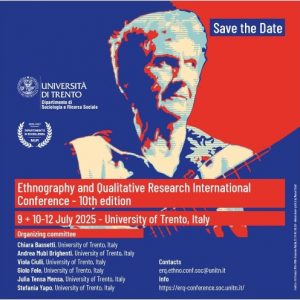
Since 2006, the Ethnography and Qualitative Research Conference, held in Bergamo for its first seven editions, has become an increasingly recognised and established scientific meeting for social researchers. Organised every two years, the initiative has grown both in terms of numbers (the 2023 edition brought together almost 600 scholars) and international impact (half the participants came from outside Italy).In 2025, the journal Etnografia e Ricerca Qualitativa (ERQ) and the University of Trento will host the 10th edition of the Ethnography and Qualitative Research International Conference (10-12 July 2025), consolidating the rich intellectual discussion spurred by previous editions. Researchers from across disciplines and fields, including sociology, anthropology, political sciences, arts & humanities, education, social work, geography, cultural studies, science and technology studies, and gender studies, are welcome to present their research and discuss their cutting-edge findings in a lively, informal environment.
Session 13 Creative/Inventive Methods in Contemporary Ethnographic Inquiry
Within the 10th ERQ Conference, Paolo Landri, director of the Institute for research on innovation and services for development of the National Research Council of Italy (Cnr-Iriss), and Fabio M. Esposito, research fellow at the Institute for research on population and social policies of the National Research Council of Italy (Cnr-Irpps), are chair of the Session focusing on Creative/Inventive Methods in Contemporary Ethnographic Inquiry.
Over the past few decades, the range of techniques and methodologies used in ethnography and social sciences has expanded, embracing innovative – and sometimes “unconventional” approaches – to tackle contemporary research questions that traditional methods often fail to address. In this landscape, the use of “creative” or “inventive” approaches has gained momentum in academic environments, giving birth to a set of theoretical and methodological approaches included in the so-called “Creative Methods for Social Sciences”.
Creative methods embrace a wide range of techniques and possible fields of application in and out of academic research and are positioning themselves as an interesting opportunity to explore new objects and dimensions of social research. On the other hand, they also pose new theoretical and methodological challenges. In this framework, this panel will explore the developing role of creative methods in ethnographic research by welcoming papers addressing issues and question such as, but not limited to:
– Methodological challenges (gathering, organizing and analysing creative data; mixing techniques
– Transformative dimensions (Impact on Policy and Communities, impact on subjects, etc.)
– Scenarios, Case Studies & Contexts of Application (education, community-based research, health and wellbeing, urban studies, conflict resolution, environmental justice, corporate or organizational settings, etc.)
– Dissemination of results (challenges of representing creative data, non-traditional dissemination formats, etc.)
– Ethical issues (intellectual property, representation and voice, intrusivity, etc.)
– Epistemological and theoretical considerations (validity, subjectivity and reflexivity; the role of the researcher, etc.)
Important Information
Deadline for submission: January 24th, 2025
How to submit: https://erq-conference.soc.unitn.it/call-for-contributions/
Per informazioni:
Paolo Landri
Cnr-Iriss
paolo.landri@cnr.it
Vedi anche:
December 17th, 2024

In continuity with the activities developed within the AESOP and consistently with the role of Gabriella Esposito and Stefania Ragozino as members of the Association’s Advisory Board and scientific coordinators of the Thematic Group on “Public Spaces and Urban Cultures” (respectively from 2015-2019 and 2021-2023), the Institute for Research on Innovation and Services for Development (Cnr-Iriss) is glad to announce the 37th AESOP Congress Planning as a Transformative Action in an Age of Planetary Crisis, (Instanbul, 7-11 July 2025).
Grounded on themes of common interest, the 37th Conference of the Association of European Schools of Planning seeks to address these interconnected challenges through the lens of spatial justice, ethics and care. The initiative is aimed to foster a dialogue on how planning can become a vehicle for addressing not only environmental crises but also the socio-spatial inequalities that exist within cities and regions. Planning has the power to reshape urban environments to ensure that access to resources, public spaces, and opportunities are distributed more equitably.
The growing frequency of extreme climate events, pandemics like COVID-19, international conflicts, homelessness, unemployment, urban refugees, and food insecurity are not isolated issues but interconnected symptoms of a much larger planetary crisis. At the heart of this crisis is a socio-economic system that continues to rely on unsustainable practices, reinforcing deep-seated inequalities and social exclusion. These dynamics underscore the urgent need to rethink the relationship between economic growth, environmental sustainability, and socio-spatial justice.
In this age of planetary crisis, the time has come to rethink and investigate the role of spatial planning as a transformative tool to foster sustainable development while prioritizing ecological and social justice. The Conference aims to connect ecological priorities with social justice goals, thereby bridging the gap between environmental sustainability and the need for equitable, inclusive, and resilient communities. It will serve as a unique forum to discuss and reimagine planning as a crucial agent of change to inspire innovative approaches that pave the way for transformative action toward cities and societies that are more just and sustainable for all.
Please submit your abstract here.
Deadline for abstract submissions (Congress Tracks): 15 January 2025
General Questions: aesop2025@yildiz.edu.tr
Abstract Submission Questions: aesop2025.abstract@yildiz.edu.tr
Per informazioni:
Stefania Ragozino
CNR – Istituto di Ricerca su Innovazione e Servizi per lo Sviluppo
s.ragozino@iriss.cnr.it
Vedi anche:
December 17th, 2024
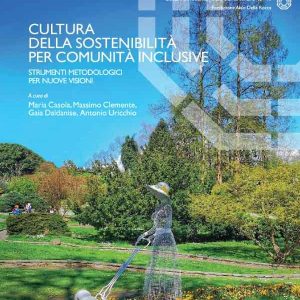
È stato pubblicato il volume dal titolo “Cultura della sostenibilità per comunità inclusive. Strumenti metodologici per nuove visioni”, a cura di Maria Casola (università di Bari), Massimo Clemente (direttore dell’Istituto per le tecnologie della costruzione – Cnr-Itc), Gaia Daldanise (Istituto di ricerca su innovazione e servizi per lo sviluppo – Cnr-Iriss), Antonio Felice Uricchio (Istituto di ricerca sulle acque – Cnr-Irsa).
L’opera, edita da Aracne, si propone di approfondire il tema della cultura della sostenibilità secondo un approccio interdisciplinare attraverso prospettive innovative e visioni condivise dal mondo della ricerca, dell’impresa e del sociale. In particolare, il volume esplora processi di tutela e partecipazione, sistemi integrati di cura e valorizzazione comunitaria del patrimonio culturale e naturale, con annesse problematiche relative al quadro storico giuridico e legislativo, approcci di rigenerazione e sviluppo territoriale con il coinvolgimento della comunità e le implicazioni legate alla creatività nonché strumenti innovativi per la transizione ecologica al fine di esplorare nuovi approcci culturali alla sostenibilità in linea con l’Agenda 2030.
La parte I, “Patrimonio culturale e naturale: tutela, valorizzazione e partecipazione”, affronta per prima cosa la sfida delle forme di tutela, cura e approcci di governance e management del patrimonio culturale. Il patrimonio culturale custodisce le storie e le conoscenze locali delle persone (ciò che l’Accordo di Parigi definisce “tecnologie endogene”): dimostra le cause dei cambiamenti storici e il modo in cui le persone si sono adattate ad essi realizzando approcci integrati nella valorizzazione del patrimonio.
Nella parte II, “Sviluppo territoriale e rigenerazione sostenibile: cultura, creatività e comunità”, viene approfondito il ruolo delle strategie culturali, delle attività culturali e creative e delle comunità nelle politiche di rigenerazione territoriale. Tali approcci aiutano a rivelare la natura e l’effetto della cultura e della creatività come metodo di pianificazione nel coinvolgimento della comunità. Infatti la pianificazione culturale, collaborativa e creativa è un percorso di consultazione inclusiva e contemporaneamente un processo decisionale che supporta le istituzioni e le organizzazioni a ripensare come le risorse culturali possano aiutare strategicamente una comunità a raggiungere i suoi obiettivi civici e di sviluppo sostenibile.
La parte III, “Transizione ecologica: prospettive e strumenti innovativi”, esamina approcci e strumenti a servizio del patrimonio culturale e naturale analizzando le pratiche inclusive che alimentano l’integrazione dei valori naturali, tecnologici e culturali per uno sviluppo sostenibile che offra spazi materiali ed immateriali, fisici e virtuali, per modalità collettive, improvvisate e riflessive di agire e pensare a futuri incerti come quelli delineati dai nuovi scenari della transizione ecologica e del cambiamento climatico.
Nella parte IV, “Cultura della sostenibilità e comunità inclusive: patrimonio culturale e imprese culturali e creative sostenibili”, il volume termina con alcune domande poste a testimoni privilegiati – stakeholder afferenti al mondo della cultura e della ricerca – con il fine di attualizzare e proiettare i temi di approfondimento affrontati dagli Autori nei vari contributi. Questo con la prospettiva di costruire una visione futura, in cui la “cultura della sostenibilità” viene interpretata come bene comune orientato a processi di sviluppo innovativi, culturali e creativi per comunità sempre più inclusive.
Le interviste sono state sviluppate su due prospettive: “Cultura della sostenibilità e processi di sviluppo innovativi per la valorizzazione del patrimonio”, “Comunità inclusive e imprese culturali e creative made in Italy per lo sviluppo sostenibile”.
Per informazioni:
Gaia Daldanise
Via Cardinale Gugliemo Sanfelice 8, 80134, Napoli
gaia.daldanise@cnr.it
Vedi anche:
December 12th, 2024
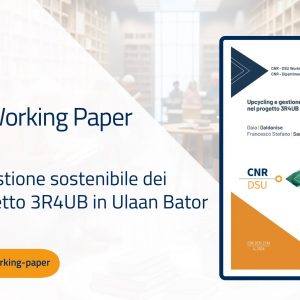
Le sfide attuali per raggiungere la neutralità climatica entro il 2050 ci spingono a ripensare politiche, processi decisionali e modelli di gestione delle risorse ambientali, sociali, economiche e culturali. In questo contesto, il dibattito scientifico mette in luce l’interesse per tematiche come l’implementazione dell’innovazione tecnologica, il contributo delle imprese nei Paesi in via di sviluppo e la sensibilizzazione sugli SDGs. Le principali difficoltà nell’attuazione di tali temi si incontrano in particolare in Paesi, come la Mongolia, spesso caratterizzati da ecosistemi fragili e minori risorse per bilanciare sviluppo economico e tutela ambientale. Il progetto di ricerca e cooperazione internazionale “The 3Rs for a sustainable use of natural resources in Ulaan Bator – 3R4UB” rappresenta un’opportunità per esplorare le sinergie tra la pianificazione della gestione dei rifiuti, il coinvolgimento civico, le consultazioni con gli stakeholder e l’adozione di modelli di finanziamento verde. Il team di ricerca internazionale si propone di sviluppare un metodo innovativo che mira non solo ad incentivare l’adozione di comportamenti sostenibili, come il riciclo e l’upcycling, ma soprattutto a promuovere la cooperazione tra cittadini e stakeholder per rafforzare il tessuto comunitario e favorire la resilienza sociale.
Come citare
Daldanise, Sammarco (2024). Upcycling e gestione sostenibile dei rifiuti nel progetto 3R4UB in Ulaan Bator (Mongolia) (CNR-DSU Working Paper 4). CNR-Dipartimento di Scienze Umane e Sociali, Patrimonio culturale. https://doi.org/10.36134/CNRDSUWP-2024-4.
December 2nd, 2024
Il CNR – Istituto di Ricerca su Innovazione e Servizi per lo Sviluppo ai fini della realizzazione del Progetto “The 3Rs for a Sustainable Use of Natural Resources in Ulaan Bator – 3R4UB”, finanziato dalla Commissione Europea nell’ambito del Programma Asia SWITCH (CUP B54D19000270006), intende avvalersi della collaborazione di un esperto di elevata professionalità per lo svolgimento della seguente attività:
Activity 1.2.14 bis Business Sustainable development experts middle to support the validation by the local administrations of the sustainable waste management masterplan delivered to UB city. Attività di supporto alla validazione da parte degli enti locali della Municipalità di UB City del masterplan per la gestione sostenibile dei rifiuti.
Competenze richieste:
- Laurea Magistrale in Architettura
- Esperienza pregressa di “mapping and environmental assessment within decision making processes and co-design of sustainable and circular practices”
- Conoscenza di pacchetti GIS, Grafica e Valutazione ambientale strategica
- Conoscenza della lingua inglese
Requisiti del collaboratore:
Esperto di mappature georeferenziate, civic engagement e processi valutativi a supporto della pianificazione sostenibile delle risorse ambientali.
November 26th, 2024
Il CNR – Istituto di Ricerca su Innovazione e Servizi per lo Sviluppo ai fini della realizzazione del Progetto PS-U-GO — “Education in Living Labs: Participatory Skills for sustainable Urban Governance”, project code: 2023-1-CY01-KA220-HED-000158284, Erasmus+ KA220-HED – Cooperation partnerships in higher education, Call 2023, Commissione Europea, CUP B73C24000650006, presente nel Piano di Gestione CNR- IRISS con codice DUS.AD023.019., intende avvalersi della collaborazione di un esperto di elevata professionalità per lo svolgimento della seguente attività: Attività di supporto all’implementazione dell’Urban Living Lab Naples del progetto PS-U-GO attraverso l’ingaggio degli attori della quadrupla elica (ricerca, istituzioni pubbliche, privati, cittadini e gruppi civici) con particolare riguardo alla componente educativa a cui si rivolge il progetto.
Competenze richieste:
- Competenze in materia di comunità educanti e patti educativi. Utilizzo di strumenti e metodi per l’ingaggio, l’ascolto e la sensibilizzazione delle comunità.
- Conoscenza delle lingue: inglese
Requisiti del collaboratore:
- Diploma di laurea in Sociologia – conseguito secondo la normativa in vigore anteriormente al D.M. 509/99, oppure della Laurea in Specialistica/Magistrale (D.M. 5 maggio 2004).
- Esperienza professionale di almeno 5 anni in processi di ricerca-azione e innovazione sociale nell’ambito di attività educative, scientifiche, di divulgazione e/o progetti di ricerca nazionali ed internazionali. Esperienza in processi di gestione collaborativa di beni comuni urbani.
November 21st, 2024
Il CNR – Istituto di Ricerca su Innovazione e Servizi per lo Sviluppo ai fini della realizzazione del Progetto PS-U-GO — “Education in Living Labs: Participatory Skills for sustainable Urban Governance”, project code: 2023-1-CY01-KA220-HED-000158284, Erasmus+ KA220-HED – Cooperation partnerships in higher education, Call 2023, Commissione Europea, CUP B73C24000650006, presente nel Piano di Gestione CNR- IRISS con codice DUS.AD023.019., intende avvalersi della collaborazione di un esperto di elevata professionalità per lo svolgimento della seguente attività: Attività di ricerca a supporto dell’implementazione dell’Urban Living Lab Naples del progetto PS-U-GO per quanto riguarda l’ingaggio e la facilitazione del processo partecipativo degli attori della quadrupla elica (ricerca, istituzioni pubbliche, privati, cittadini e gruppi civici).
Competenze richieste:
- Utilizzo di strumenti e software per attività di community engagement, data collection ed elaborazioni grafiche, modellazione vettoriale, modellazione 3D, utilizzo di Geographic lnformation System (GIS).
- Conoscenza delle lingue: inglese
Requisiti del collaboratore:
- Diploma di laurea in Architettura – conseguito secondo la normativa in vigore anteriormente al D.M. 509/99, oppure della Laurea Specialistica/Magistrale (D.M. 5 maggio 2004).
- Esperienza di ricerca e sperimentazione in ambito di processi di community engagement in attività scientifiche e/o progetti di ricerca nazionali ed internazionali.
November 20th, 2024
« Previous Page —
Next Page »